- Language: en
- Documentation version: 1.3.1
Bolus Dose
A bolus dose represents an instantaneous increase in the amount of a drug in a specific compartment. Physiologically it represents an injection where the drug is assumed to be well distributed within the compartment within a negligible time period.
Note
See the Bolus Dose with no elimination. for Tut Script used to generate results in this section.
The mathematical expression for a bolus at time  in compartment Central is:-
![s[CENTRAL] = s[CENTRAL] + B(t)](../../../_images/math/edcfc7d6e1848440f966da3ba2a90203d68649d1.png)
where:-
![B(t)=
\Biggl \lbrace
{
\text{c[AMT]} ,\text{ if } { t = t_B }
\atop
0.0, \text{ otherwise }
}](../../../_images/math/20ded2b4e70241c6654e8a1f61bc5bac058fcf4f.png)
In PoPy, we add a bolus dose to a given compartment (e.g. Central) using the DERIVATIVES section of the script:
d[CENTRAL] = @bolus{amt: c[AMT], lag: m[LAG]} + ...
Because the dose amount is usually fixed by the experiment, it is typically included in the input data and is therefore a column (or covariate) and encoded as such, e.g. c[AMT].
The lag time, however, is usually estimated as a model parameter and would typically be coded as such, e.g. m[LAG]. If lag time is not included in the bolus function, it defaults to zero:
d[CENTRAL] = @bolus{amt: c[AMT], lag: 0.0} + ...
which is exactly the same as
d[CENTRAL] = @bolus{amt: c[AMT]} + ...
See @bolus for some more syntax examples.
The cumulative amount in the compartment (with no elimination) is therefore a step function (Fig. 4):
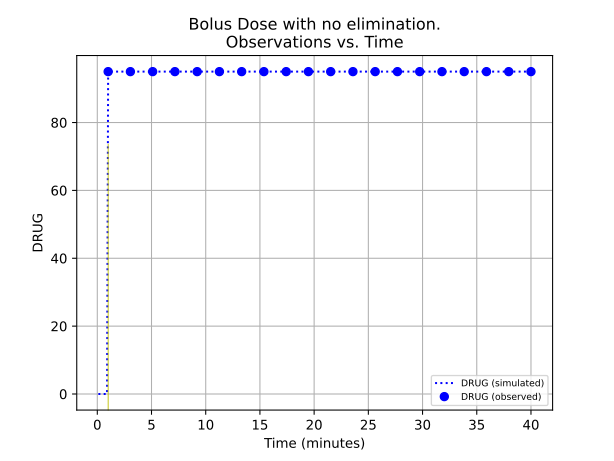
Fig. 4 Cumulative amount following a bolus dose with no elimination
An example of a bolus dose added to a one compartment model with no lag time is:
DERIVATIVES: |
    d[CENTRAL] = @bolus{amt:c[AMT]} - c[CL]*s[CENTRAL]/c[V]